There’s a phrase I hear in almost every organisation I work with:
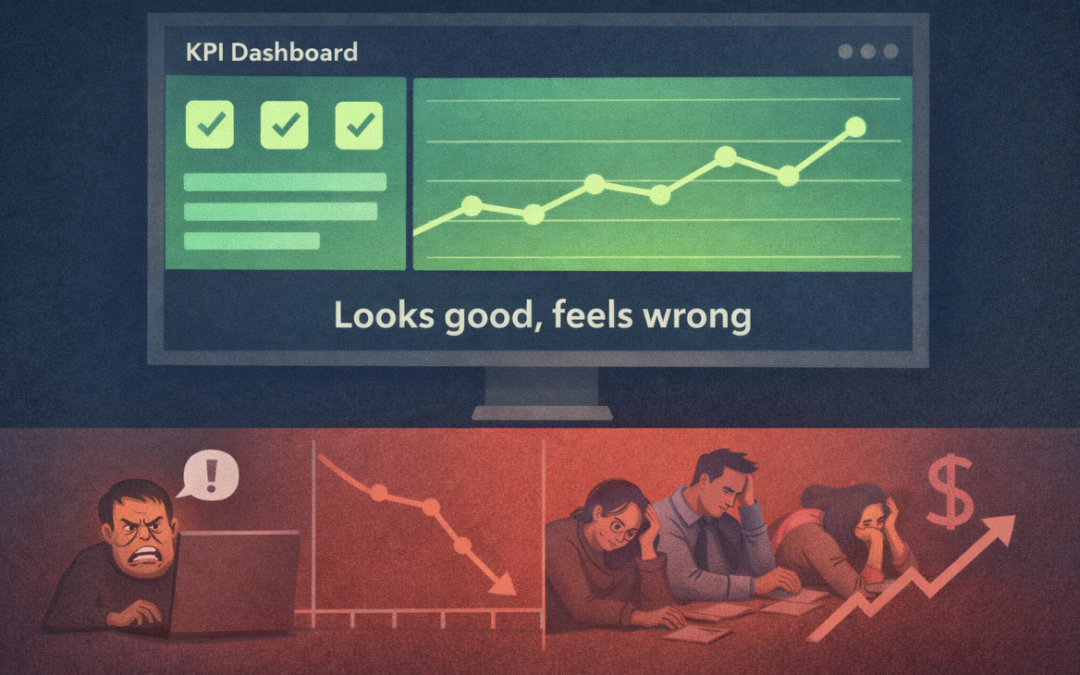
“Those numbers have nothing to do with what we actually do.”
That sentence contains more diagnostic value than most dashboards.
It tells you that the people closest to the work don’t recognise themselves in the measures being used. And when people don’t see their reality reflected in the data, they disengage from it. Quietly. Politely. Completely.
This is how cynicism about measurement starts. Not with bad intentions, but with a gap between what gets measured and what people know to be true about their work.
The reporting problem
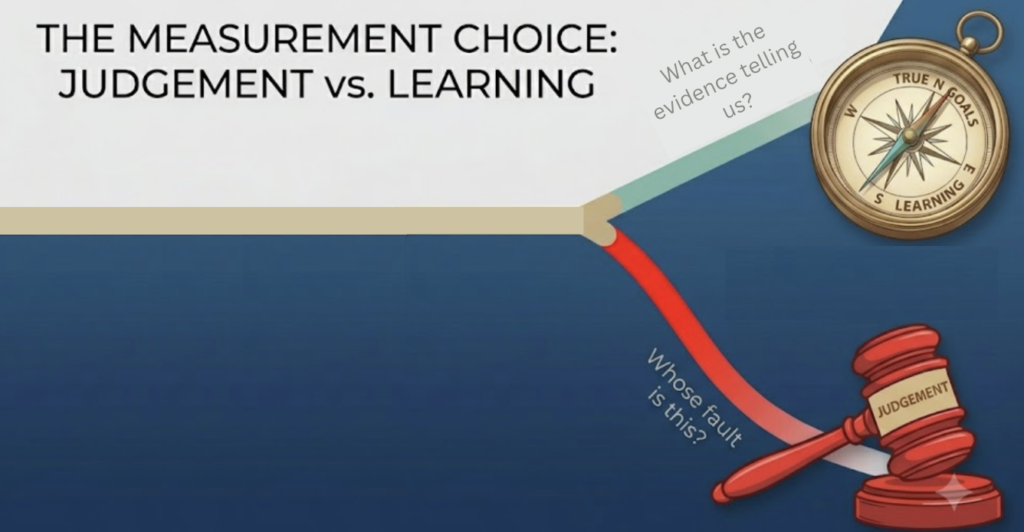
Most organisations use measurement the way schools use grades. Results come in. Numbers go up or down. Someone asks “why did this drop?” and everyone hears “whose fault is this?”
In this model, measurement is something done to people, not with them. Data arrives from above. Targets are set without input. And the review meeting becomes a ritual of defence and explanation rather than learning.
The predictable response? People lower their targets so they can hit them. They present data selectively. They choose easy measures. They game the system or data. They stop raising problems because problems become evidence of failure rather than signals for improvement.
None of this is dishonest. It’s rational behaviour in a system that uses measurement as judgement.
What changes when people help build the measures
A couple of weeks ago, I wrote about Phil Jackson’s triangle offense: a system where every player touched the ball on every possession. The insight wasn’t tactical. It was cultural: people who are included in the process take ownership of the outcome.
The same principle applies to measurement.
When a team is invited to answer the question “what does success look like at our level?” and then participates in defining the measures that would evidence that success, something shifts.
The measures stop feeling arbitrary. They start feeling relevant. Because the people who do the work have shaped the definition of what “working” looks like.
This isn’t about making people feel good. It’s about making measures relevant. The people closest to the work understand the nuances that leadership often can’t see from a strategic altitude. Their input doesn’t just create buy-in, it creates better measures as well.
From judgement to learning
When measurement shifts from a judgement tool to a learning tool, the questions asked change.
“Why did this drop?” becomes “what is this data telling us?”
“Who is responsible?” becomes “what in our process is producing this result?”
“Are we hitting our target?” becomes “are we seeing evidence of the change we intended?”
These aren’t just nicer questions. They’re more useful questions. They lead to root causes instead of blame. They lead to adjustments instead of defensiveness. They lead to the kind of conversations where someone walks in with their own analysis, not because they were told to, but because they want to understand.
That moment, when a team member voluntarily brings data to a meeting because they’re genuinely curious about what it shows, is the clearest signal that measurement culture has shifted.
The shared language underneath
This shift requires something that most organisations skip: a shared language for results.
When one team says “quality” and means defect rates, while another team means ease of use, alignment is an illusion.
A shared language means that results, measures, and targets carry the same meaning for everyone. It means that when someone says “we’re improving operational efficiency,” every person in the room pictures the same observable outcome.
Building that language isn’t automatic. It requires someone to pause and ask: “what exactly do we mean by this?” PuMP calls this precision of language fundamental and treats it as a prerequisite for meaningful measurement, not an afterthought.
The real shift
Cynicism about KPIs is not a people problem. It’s a design problem. When measures are imposed without input, defined in a way that doesn’t match reality, and used primarily to judge rather than learn, cynicism is the rational response.
Ownership emerges when the opposite is true. When people help define what success looks like. When the language is precise enough that everyone shares the same picture. When data is treated as a compass, not a verdict.
The transformation isn’t dramatic. It’s a shift in how one question gets asked from “are you hitting your numbers?” to “what is the evidence telling us that we are reaching our goals?”
When a stain appears on your ceiling, the leak is almost never directly above it.
Water travels. It enters through a hidden crack, runs invisibly along a structural beam, and surfaces in a room far from its source. Repaint the ceiling all you like! But until you find the actual pipe, the stain always returns.
Organizations operate the exact same way. Yet, most leaders spend years repainting corporate ceilings.
The Illusion of Localized Solutions
In a connected corporate system, the place a problem shows up and the place it comes from are often entirely different rooms. When a failure surfaces somewhere visible, the instinctive executive reflex is to deploy an immediate solution directly on the symptom. Things improve for a while. Then, after a couple of months the problem returns.
Look at how this blindness plays out across two familiar examples:
The Talent Crisis (High Turnover): Frontline teams are burning out, talented employees are leaving. The visible problem is localized, so the response is local: better recruitment agencies, faster hiring loops to close the gap, and retention bonuses to keep your talent. Turnover dips, then climbs again. Why? Because the cause lives nowhere near the frontline. Consistent work overload due to poor planning, or wrong assignments, or undefined coordination and responsibilities could be the underlying reason. No amount of frontline recruitment or bowling tournaments will retain frustrated talent.
The Revenue Loss (Customer Churn): A subscription business starts losing users. The churn shows up in the dashboard monitored by the retention team. The response is immediate: aggressive discounts, win-back campaigns, and loyalty perks. Churn starts to slow down, then increases again. Why? Because customers are leaving due to upstream failures the retention team cannot touch: a confusing onboarding experience, features promised in sales that were never built, or a support process that frustrates rather than resolves. The symptom shows itself in retention; the problem is somewhere else.
Why Good Measures Don’t Rescue You
This recurring failure is not a breakdown of measurement.
Your talent voluntary turnover rate could be a perfectly valid metric. Your churn rate could be a flawless indicator. They are doing exactly what they were designed to do: proving to you, with evidence, that a strategic result is failing. The measures are correct. The location where the alarm is sounding is correct.
The breakdown happens in the strategic response.
The corporate instinct is to spend budget where the number is bad. But a metric only tells you where the water finally surfaced! It cannot track the trajectory of the leaking pipe.
Finding the pipe requires a shift in discipline. It demands that leadership steps back to see the entire system of connected results, maps how they influence one another, and traces the symptom back through those relationships to its actual origin. The true point of leverage is almost never where you were originally looking.
The Compounding Cost of Fragmented Action
When this essential step is skipped, a devastating form of organizational friction occurs. Different teams begin responding to their local symptoms of the exact same hidden cause:
HR dives into to various retention actions and invests in more onboarding and training programmes.
Operations tightens its scheduling and approves overtime to keep things running.
Finance, watching recruitment and overtime costs climb, pushes for tighter cost controls.
Customer service, noticing quality slipping because teams are always new and stretched, launches a service-improvement initiative.
Everyone is working exhausting hours on their visible piece of the puzzle. But because no one has traced the problem to its shared cross-functional origin, all that localized effort pulls the organization in conflicting directions. It is highly active, significantly expensive, and completely ineffective. The company looks busy. The root cause remains perfectly protected by the noise of the activity meant to fix it.
This is why systemic, mapped measurement is inseparable from execution. A connected view of your organizational performance doesn’t just show you a dashboard—it gives you the blueprint to follow the water back to the pipe, instead of funding four different departments to repaint four different ceilings at once.
This connected view of results is exactly what the PuMP methodology’s Results Map provides — it makes the links visible on a single page and shows you where to dig deeper. (See comments for more on this powerful tool.)
The Uncomfortable Question
Look at your strategic roadmap for the upcoming quarter. Consider the consistent “focus area” or the chronic operational issue your organization keeps returning to year after year despite real effort and aggressive spending.
Are you treating the room where the problem appears, or the place where it actually begins?
If you are just repainting the ceiling, the stain will come back. It always does.
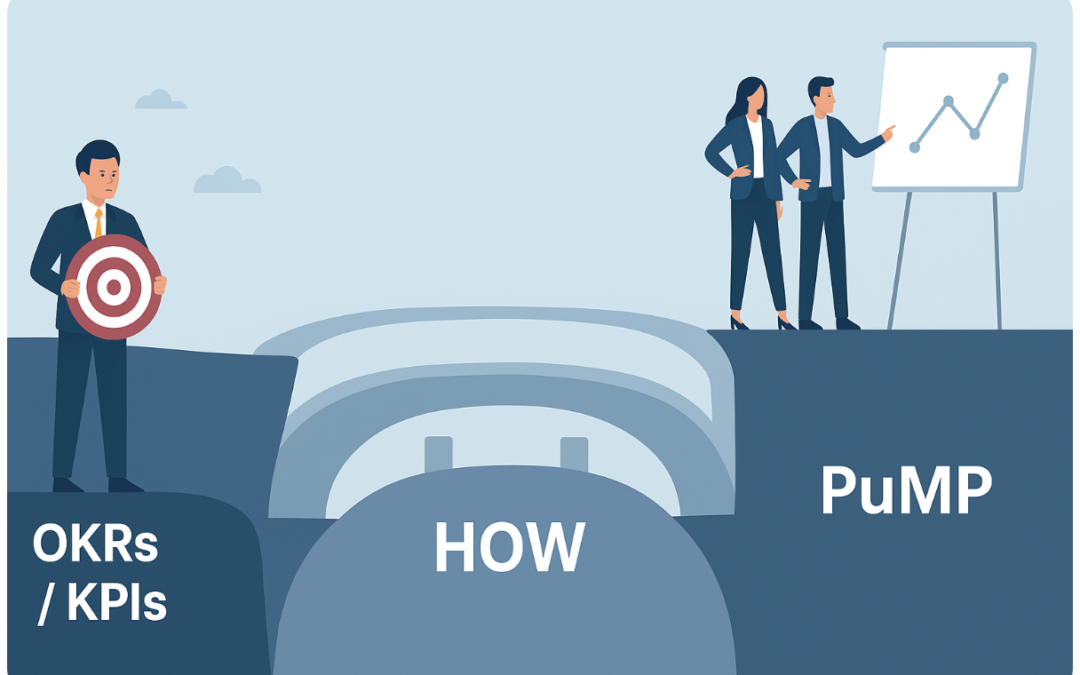
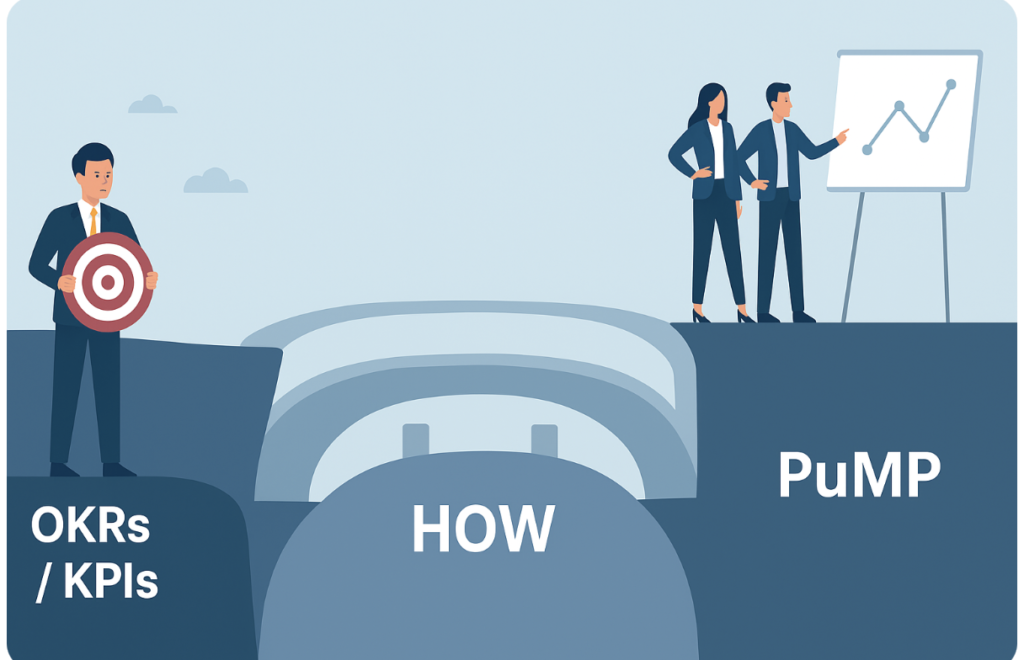
OKRs vs. KPIs… what’s the difference? Do we really need to keep discussing this?
This debate or confusion you might say has been going on for a long time now. But what if the answer is simpler than we think?
Everywhere I look, I see posts and videos comparing the two, but I think these conversations are missing the essential point.
In PuMP’s approach, it doesn’t have to be this complicated with all the overlapping and confusing terminology.
With a simple approach:
There are things we want to improve
There are things we want to stay as is.
What To Do if We Want Improvement
Here’s a 5-step process that we use in PuMP if we want improvement and should be valid no matter which approach you prefer to use:
1. Always Start With the Goal
Every business has goals or objectives – PuMP calls them performance results. These are simply the things you want to improve – the focus of the organization’s strategy.
For example:
We don’t want any customer to have a complaint from our services (because currently we have and it increased recently, and it’s making us lose our customers).
So, the performance result (or goal) we want to achieve could be: We receive no customer complaints.
We want or systems run without any interruptions (so many system failures occur during a week that causes interruptions in our operations, making us lose time and causes waste).
So, the performance result (or goal) we want to achieve could be: Our systems run without any downtime.
2. Design a Meaningful Measure or KPI for the Goal
You design performance measures – which should be the quantitative and objective evidences of those goals results.
For example:
Number of customer complaints per month
% of downtime duration of the systems per week
3. Measure and Learn the Current Performance of the Measures/KPIs to Set Meaningful Targets
You measure your current performance (the baseline performance) and set target values for the performance you want in the future.
For example:
Number of customer complaints per month is currently 20 (varying between 15 and 25). We want to decrease it to 10 customer complaints per month by the end of this year.
% of downtime duration of the systems per week is currently 7% (varying between 2% and 12%). We want to decrease it to 3% per week in 6 months.
4. Understand What Causes the Difference Between the Current and Target Performance
Make root cause analysis to find:
What constrains your system to keep the performance at this current level?
What are problems in the process flow that results in this current performance?
What are the leverage points in the system that if we change, we can reach a higher level of performance?
etc.
5. Select an Improvement Action
You then select and implement improvement actions to close the gap between the current performance and the targeted performance. These are the improvement projects or change initiatives you decide on or actions you take.
For example:
Launch a customer success program to better understand customer needs and redesign related processes to meet those needs.
Upgrade the most problematic modules of our systems
to prevent downtime.
Where do you Want no Improvement but Maintain the Current Performance Level?
And, there are areas where you need stability, not improvement. In those cases, you still measure and you can call them performance measures – but you don’t set targets, you just monitor to make sure performance holds and stays as-is
For example:
You want to quickly respond to your clients and you measure “average monthly response duration” to track it. Its current performance is 1 day, (varying between 0.5 – 1.5 days). You think this is an acceptable duration to respond to a client. So, you can track this measure only to ensure you keep this current performance in control.
And that’s all you need to understand and know!
So in summary, you have performance measures for two different purposes: evidences of your improvement focus and evidences of your business-as-usual stable performance.
The OKR Terminology
Now, let’s look at OKRs:
The “O” (Objectives) are essentially performance results. (like: we receive no customer complaints from our services)
The “KR” (Key Results) are basically performance measures with target values. (like: decrease customer complaints from 20 to 10 in 6 months)
KPIs are for business-as-usual performance.
So, the concepts overlap. The real issue is not whether you choose OKRs or KPIs. The real issue is having a solid measurement methodology behind them and knowing the reason why you measure.
Without a supporting methodology, OKRs can sometimes drift into vague intentions, activity lists, or wishful numbers.
That’s where PuMP makes the difference. PuMP provides that missing ‘how-to’ steps, making OKRs practical, evidence-based, and actionable:
✔️ How to word goals so they’re measurable (instead of mistaking activities for results).
✔️ How to design proper, meaningful and strong measures that become evidences of the goals are met.
✔️ How to make sure you trust the data you collect.
✔️ How to track performance (with tools like XmR charts) to get the truth out of the measures to guide improvement decisions and in the end, prove that you really reach your targets.
And in the end, it is not important what you call what as long as you follow a methodology and you have a glossary that helps everyone understand the same thing from a term.
The Bottom Line
It’s not about KPIs vs. OKRs. It’s about using a measurement process that makes whichever terms you use actually work. The distinction is about “why” you are measuring something:
to guide improvement effort, or
to monitor to ensure current performance remains as-is.
Using a methodology like this will sure ensure OKRs are properly brought to life.
What do you think — are we overcomplicating performance management with terminology instead of focusing on evidence?
Why balancing “business as usual” and “improvement” measures is essential for effective strategy execution
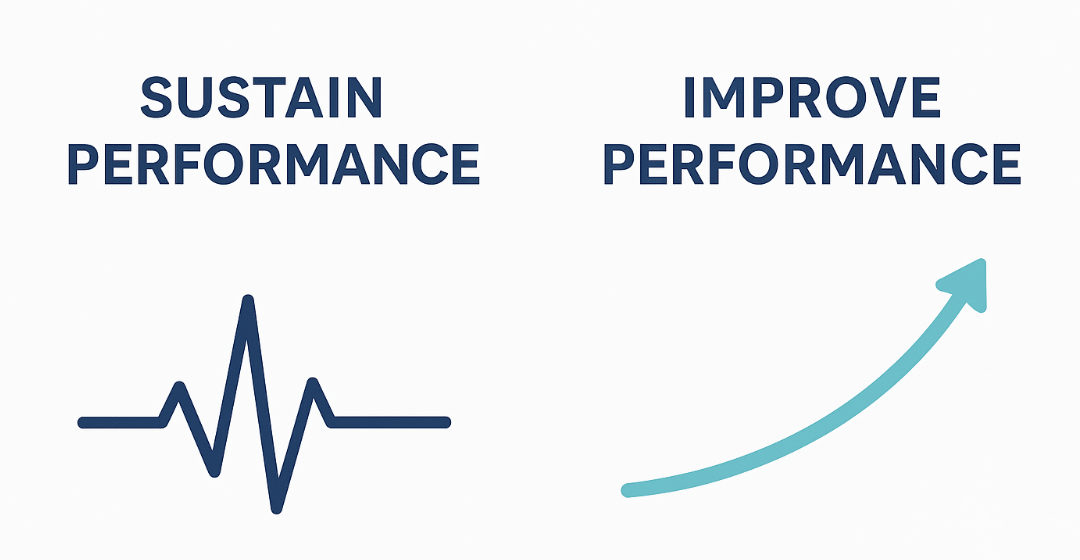
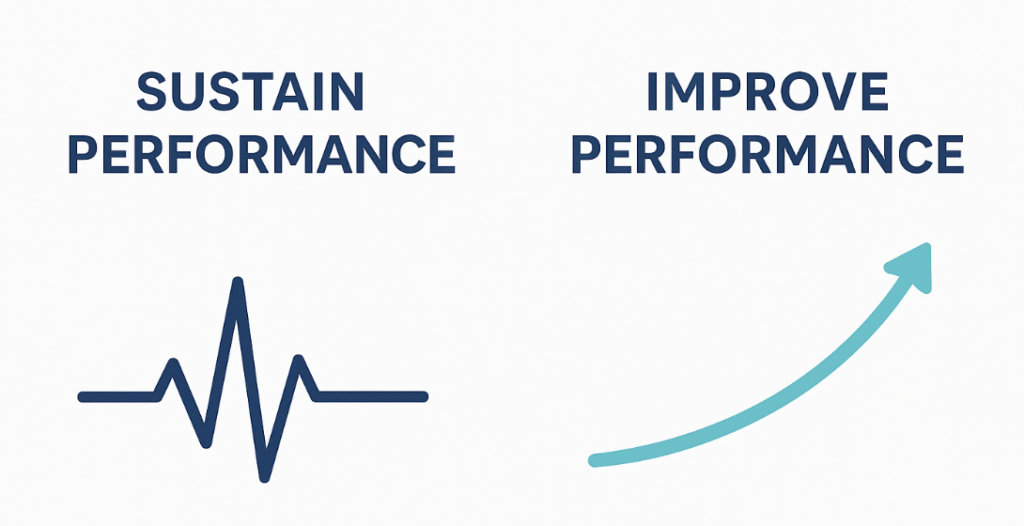
In every organization, there are two kinds of performance at play:
Business as usual — the processes and results we want to sustain at their current (acceptable) level.
Strategic improvement — the goals and results we want to elevate to a new level of performance.
Both are vital.
Yet many organizations treat them the same way — tracking everything together in one overloaded dashboard, blurring what needs attention and what doesn’t.
The result is lost focus and confusion over what truly matters.
Let’s unpack how to separate — and balance — these two types of measures.
1. It Starts with the Goal
Every meaningful measure begins with a goal.
A goal defines whether we want to maintain performance or improve it.
If what we want is to “keep customer satisfaction steady above 90%”, that’s a sustainability level we want to preserve. There is no intention for improvement, but a need to keep an eye on to ensure it doesn’t drop.
If the goal is “increase customer satisfaction from 85% to 90% by next year”, that’s an improvement goal.
It seems subtle, but this distinction changes how we manage, review, and act on measures.
Without this clarity, organizations fall into the trap of trying to “improve everything” — spreading resources thin, creating dashboard overload, and losing strategic focus.That clarity drives how we select, track, and discuss measures.
2. Tracking Measures for the Right Intent
The measure design process is no different for any type of goal we want to achieve.
If we are tracking a measure to see the changes through time, we need XmR charts. Because there is no other tool that will give you the information of what is the true performance of our measures are.
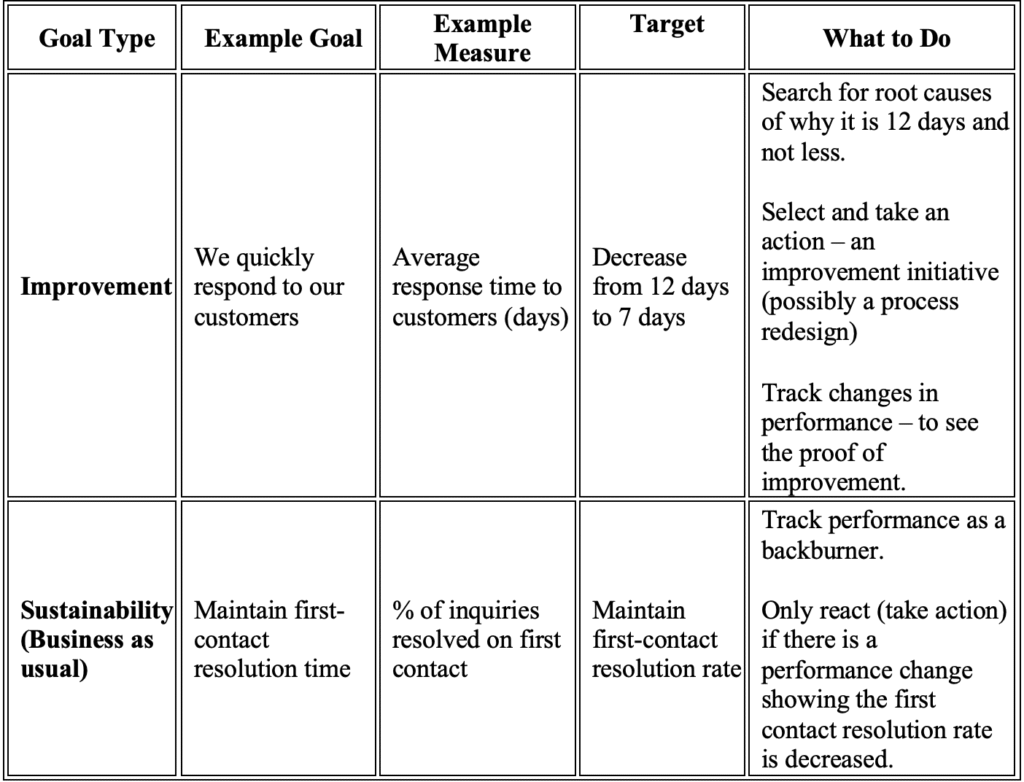
Only the purpose of tracking is different for improvement and business as usual (or backburner) measures.
For example:
Both are important — but their management attention is not the same.
3. Separate the Focus: Different Spaces for Different Conversations
One of the biggest mistakes organizations make is mixing sustainability and improvement measures in the same reports and meetings.
When everything is in one place:
The “business as usual” data crowds out the strategic improvement data.
Managers get caught firefighting stable processes instead of leading real change.
Improvement goals lose visibility and momentum.
To avoid this, it’s helpful to separate reporting and review spaces:
Operational dashboards track sustainability goals — things that must stay healthy and predictable.
Strategic performance reviews focus on improvement goals — the few areas that require deliberate, resourced change.
Or keep the topics separate in a meeting and in reports. Highlight what is on priority focus and what is not.
This separation keeps focus sharp and avoids confusing “watching” with “improving.”
4. When “Business as Usual” Needs Attention
A sustain goal doesn’t mean “ignore it.”
It means “keep an eye on it — but don’t invest improvement effort unless there’s a signal.”
If a sustainability measure shows an unwanted change — for instance, defect rates suddenly rise, or customer satisfaction drops— that’s when the “business as usual” area temporarily moves into improvement focus.
In other words:
“If performance goes off track, it becomes an improvement goal — until stability is restored.”
This flexible approach keeps the organization both stable and adaptive.
5. The Strategic Value of Separation
Distinguishing between sustainability and improvement measures isn’t about adding complexity — it’s about clarifying intent.
It ensures:
Improvement efforts target the right priorities.
Resources are not wasted on already stable areas.
Operational teams know what to monitor.
Leaders can focus reviews on the few goals that truly drive change.
In short, it builds discipline into strategy execution.
The Takeaway
Not every measure should be improved.
Some should simply be sustained — and that’s perfectly healthy.
The art of performance management lies in knowing which is which, and treating them differently.
Together, they form a balanced system — stable where it should be, and improving where it must.
Which of your current KPIs belong to “business as usual” — and which truly represent your organization’s focus for improvement?
Recent Comments