There’s a phrase I hear in almost every organisation I work with:
“Those numbers have nothing to do with what we actually do.”
That sentence contains more diagnostic value than most dashboards.
It tells you that the people closest to the work don’t recognise themselves in the measures being used. And when people don’t see their reality reflected in the data, they disengage from it. Quietly. Politely. Completely.
This is how cynicism about measurement starts. Not with bad intentions, but with a gap between what gets measured and what people know to be true about their work.
The reporting problem
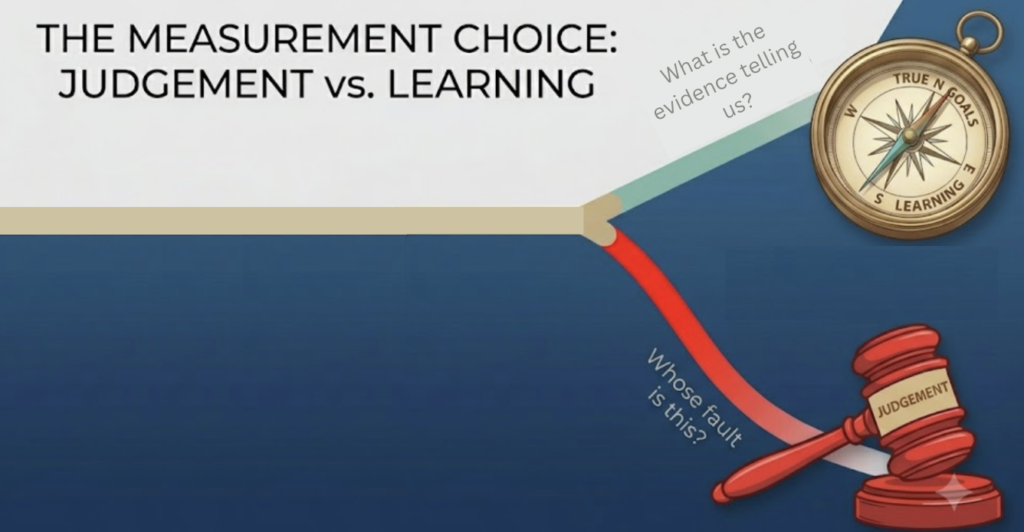
Most organisations use measurement the way schools use grades. Results come in. Numbers go up or down. Someone asks “why did this drop?” and everyone hears “whose fault is this?”
In this model, measurement is something done to people, not with them. Data arrives from above. Targets are set without input. And the review meeting becomes a ritual of defence and explanation rather than learning.
The predictable response? People lower their targets so they can hit them. They present data selectively. They choose easy measures. They game the system or data. They stop raising problems because problems become evidence of failure rather than signals for improvement.
None of this is dishonest. It’s rational behaviour in a system that uses measurement as judgement.
What changes when people help build the measures
A couple of weeks ago, I wrote about Phil Jackson’s triangle offense: a system where every player touched the ball on every possession. The insight wasn’t tactical. It was cultural: people who are included in the process take ownership of the outcome.
The same principle applies to measurement.
When a team is invited to answer the question “what does success look like at our level?” and then participates in defining the measures that would evidence that success, something shifts.
The measures stop feeling arbitrary. They start feeling relevant. Because the people who do the work have shaped the definition of what “working” looks like.
This isn’t about making people feel good. It’s about making measures relevant. The people closest to the work understand the nuances that leadership often can’t see from a strategic altitude. Their input doesn’t just create buy-in, it creates better measures as well.
From judgement to learning
When measurement shifts from a judgement tool to a learning tool, the questions asked change.
“Why did this drop?” becomes “what is this data telling us?”
“Who is responsible?” becomes “what in our process is producing this result?”
“Are we hitting our target?” becomes “are we seeing evidence of the change we intended?”
These aren’t just nicer questions. They’re more useful questions. They lead to root causes instead of blame. They lead to adjustments instead of defensiveness. They lead to the kind of conversations where someone walks in with their own analysis, not because they were told to, but because they want to understand.
That moment, when a team member voluntarily brings data to a meeting because they’re genuinely curious about what it shows, is the clearest signal that measurement culture has shifted.
The shared language underneath
This shift requires something that most organisations skip: a shared language for results.
When one team says “quality” and means defect rates, while another team means ease of use, alignment is an illusion.
A shared language means that results, measures, and targets carry the same meaning for everyone. It means that when someone says “we’re improving operational efficiency,” every person in the room pictures the same observable outcome.
Building that language isn’t automatic. It requires someone to pause and ask: “what exactly do we mean by this?” PuMP calls this precision of language fundamental and treats it as a prerequisite for meaningful measurement, not an afterthought.
The real shift
Cynicism about KPIs is not a people problem. It’s a design problem. When measures are imposed without input, defined in a way that doesn’t match reality, and used primarily to judge rather than learn, cynicism is the rational response.
Ownership emerges when the opposite is true. When people help define what success looks like. When the language is precise enough that everyone shares the same picture. When data is treated as a compass, not a verdict.
The transformation isn’t dramatic. It’s a shift in how one question gets asked from “are you hitting your numbers?” to “what is the evidence telling us that we are reaching our goals?”
But that shift changes everything underneath it.
Results before activities. Evidence before data.
Recent Comments