OKRs vs. KPIs… what’s the difference? Do we really need to keep discussing this?
This debate or confusion you might say has been going on for a long time now. But what if the answer is simpler than we think?
Everywhere I look, I see posts and videos comparing the two, but I think these conversations are missing the essential point.
In PuMP’s approach, it doesn’t have to be this complicated with all the overlapping and confusing terminology.
With a simple approach:
- There are things we want to improve
- There are things we want to stay as is.
What To Do if We Want Improvement
Here’s a 5-step process that we use in PuMP if we want improvement and should be valid no matter which approach you prefer to use:
1. Always Start With the Goal
Every business has goals or objectives – PuMP calls them performance results. These are simply the things you want to improve – the focus of the organization’s strategy.
For example:
- We don’t want any customer to have a complaint from our services (because currently we have and it increased recently, and it’s making us lose our customers).
- So, the performance result (or goal) we want to achieve could be: We receive no customer complaints.
- We want or systems run without any interruptions (so many system failures occur during a week that causes interruptions in our operations, making us lose time and causes waste).
- So, the performance result (or goal) we want to achieve could be: Our systems run without any downtime.
2. Design a Meaningful Measure or KPI for the Goal
You design performance measures – which should be the quantitative and objective evidences of those goals results.
For example:
- Number of customer complaints per month
- % of downtime duration of the systems per week
3. Measure and Learn the Current Performance of the Measures/KPIs to Set Meaningful Targets
You measure your current performance (the baseline performance) and set target values for the performance you want in the future.
For example:
- Number of customer complaints per month is currently 20 (varying between 15 and 25). We want to decrease it to 10 customer complaints per month by the end of this year.
- % of downtime duration of the systems per week is currently 7% (varying between 2% and 12%). We want to decrease it to 3% per week in 6 months.
4. Understand What Causes the Difference Between the Current and Target Performance
Make root cause analysis to find:
- What constrains your system to keep the performance at this current level?
- What are problems in the process flow that results in this current performance?
- What are the leverage points in the system that if we change, we can reach a higher level of performance?
etc.
5. Select an Improvement Action
You then select and implement improvement actions to close the gap between the current performance and the targeted performance. These are the improvement projects or change initiatives you decide on or actions you take.
For example:
- Launch a customer success program to better understand customer needs and redesign related processes to meet those needs.
- Upgrade the most problematic modules of our systems
- to prevent downtime.
Where do you Want no Improvement but Maintain the Current Performance Level?
And, there are areas where you need stability, not improvement. In those cases, you still measure and you can call them performance measures – but you don’t set targets, you just monitor to make sure performance holds and stays as-is
For example:
- You want to quickly respond to your clients and you measure “average monthly response duration” to track it. Its current performance is 1 day, (varying between 0.5 – 1.5 days). You think this is an acceptable duration to respond to a client. So, you can track this measure only to ensure you keep this current performance in control.
And that’s all you need to understand and know!
So in summary, you have performance measures for two different purposes: evidences of your improvement focus and evidences of your business-as-usual stable performance.
The OKR Terminology
Now, let’s look at OKRs:
- The “O” (Objectives) are essentially performance results. (like: we receive no customer complaints from our services)
- The “KR” (Key Results) are basically performance measures with target values. (like: decrease customer complaints from 20 to 10 in 6 months)
- KPIs are for business-as-usual performance.
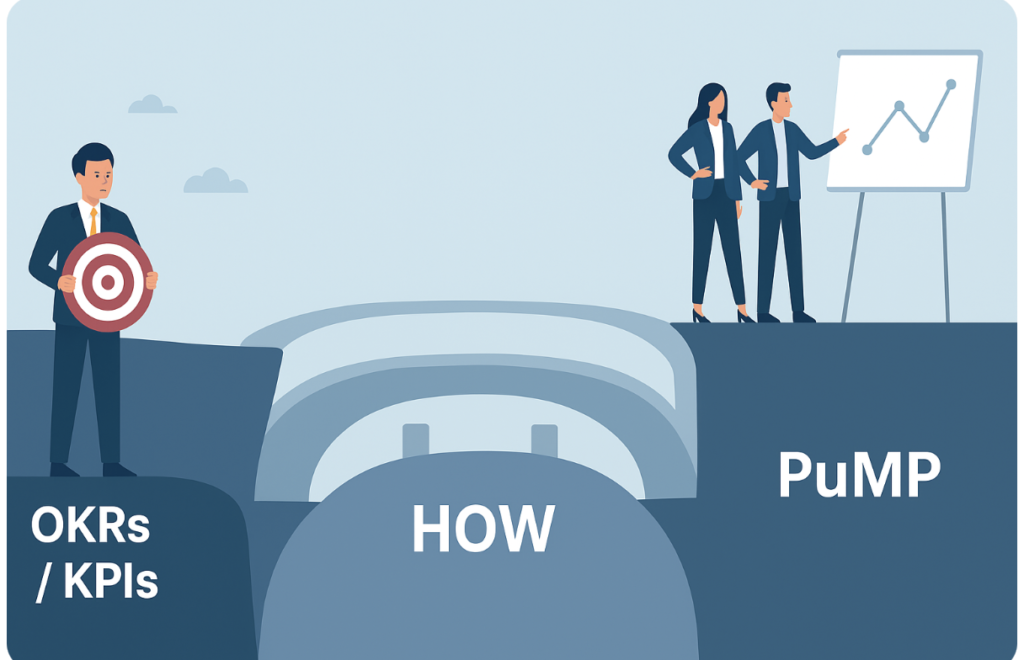
So, the concepts overlap. The real issue is not whether you choose OKRs or KPIs. The real issue is having a solid measurement methodology behind them and knowing the reason why you measure.
Without a supporting methodology, OKRs can sometimes drift into vague intentions, activity lists, or wishful numbers.
That’s where PuMP makes the difference. PuMP provides that missing ‘how-to’ steps, making OKRs practical, evidence-based, and actionable:
✔️ How to word goals so they’re measurable (instead of mistaking activities for results).
✔️ How to design proper, meaningful and strong measures that become evidences of the goals are met.
✔️ How to make sure you trust the data you collect.
✔️ How to track performance (with tools like XmR charts) to get the truth out of the measures to guide improvement decisions and in the end, prove that you really reach your targets.
And in the end, it is not important what you call what as long as you follow a methodology and you have a glossary that helps everyone understand the same thing from a term.
The Bottom Line
It’s not about KPIs vs. OKRs. It’s about using a measurement process that makes whichever terms you use actually work. The distinction is about “why” you are measuring something:
- to guide improvement effort, or
- to monitor to ensure current performance remains as-is.
Using a methodology like this will sure ensure OKRs are properly brought to life.
What do you think — are we overcomplicating performance management with terminology instead of focusing on evidence?
Recent Comments